Rue Lebeau 47 Immeuble Art Nouveau Bruxelles Bruxelles 1000 Belgium
| Top: Hôtel Tassel past Victor Horta (1893); Middle: Desk by Henry Van de Velde (1898); Bottom: Stoclet Palace past Josef Hoffmann (1905–1911) | |
| Years active | c. 1890–1910 |
|---|---|
| Country | Belgium |


The Art Nouveau movement of compages and design first appeared in Brussels, Belgium, in the early on 1890s, and quickly spread to France and to the residual of Europe. It began every bit a reaction confronting the formal vocabulary of European academic art, eclecticism and historicism of the 19th century, and was based upon an innovative use of new materials, such every bit atomic number 26 and glass, to open larger interior spaces and provide maximum light; curving lines such as the whiplash line; and other designs inspired by plants and other natural forms.
The early on Art Nouveau designers in Brussels created not but art and architecture but also furniture, glassware, carpets, and even clothing and other ornament to lucifer. Some of Brussels' municipalities, such as Schaerbeek, Etterbeek, Ixelles, and Saint-Gilles, were developed during the heyday of Art Nouveau and have many buildings in that style. Afterward 1900, the mode gradually became more formal and geometric. The final Art Nouveau landmark in Brussels was the Stoclet Palace by the Austrian architect Josef Hoffmann (1905–1911), now a UNESCO World Heritage Site, which marked the transition to a more geometric and formal style and the birth of Fine art Deco and early modernism.[1]
In spite of Brussels' city planning free-for-all between the terminate of the 2d World State of war and the tardily 1960s, Brussels nevertheless has more than 500 Fine art Nouveau buildings.
Compages [edit]
Paul Hankar [edit]
The start two Fine art Nouveau houses in Brussels were built at the same fourth dimension, in 1892–93, by the architects and designers Paul Hankar and Victor Horta respectively. They were similar in their originality, but very dissimilar in their pattern and appearance. Hankar (1859–1901), the son of a primary stone cutter, had studied ornamental sculpture and ornamentation at the Royal Academy of Fine Arts in Brussels from 1873 to 1884, whilst working equally an ornamental sculptor. From 1879 to 1904, he worked in the studio of the prominent builder Henri Beyaert, a master of eclectic and neoclassical architecture. Through Beyaert, Hankar became an admirer of Eugène Viollet-le-Duc, the French architect who advocated the use of innovative new materials such every bit iron and glass, while cartoon from historical compages for inspiration.[ii]
In 1893, Hankar designed and built the Hankar Firm, his own residence, at 71, rue Defacqz / Defacqzstraat , in the Saint-Gilles municipality of Brussels. To decorate it, he brought together the talents of several of his artist friends, including the sculptor René Janssens and the painter Albert Ciamberlani, who adorned the facade with sgraffiti, or layers of plaster tinted in pastel colours onto a moistened surface, a technique popular in Renaissance Italy in the 15th and 16th centuries. The facade and balconies featured atomic number 26 decoration and curling lines in stylised floral patterns, which became an important feature of Art Nouveau. Based on this model, he congenital several houses for his artist friends, including Janssens, Ciamberlani, the designer, silversmith and jeweller Philippe Wolfers, as well as the painter Léon Bartholomé. He also designed a series of innovative drinking glass display windows for Brussels shops, of which one, the old Chemiserie Niguet, at thirteen, rue Royale/Koningsstraat in primal Brussels, yet survives.[iii]
In 1897, Hankar designed i more important project; he was the creative director for the International Exposition held in Tervuren, virtually Brussels, which featured works by the major Belgian Fine art Nouveau artists, including Gustave Serrurier-Bovy, Henry Van de Velde, and George Hobé. He died in January 1901 at the historic period of 41, but his mode influenced the work of younger Brussels' artists, including Paul Hamesse, Léon Sneyers, Antoine Pompe and the modernist Victor Conservative.[2]
-
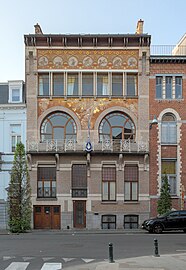
Business firm of the painter Albert Ciamberlani by Hankar, with sgraffito murals (1897–98)
Victor Horta [edit]
At the same fourth dimension Hankar was working on his house, Victor Horta (1861–1947) was edifice a very different kind of Fine art Nouveau business firm in Brussels, the Hôtel Tassel, for the scientist and professor Émile Tassel.[4] Horta, born in Ghent, was the son of a shoemaker, who had studied architecture at the Royal Academy of Fine Arts in Ghent, then at the Academy of Fine Arts in Brussels. He afterwards worked for the neoclassical builder Alphonse Balat, who was in the midst of constructing the enormous drinking glass and atomic number 26 Purple Greenhouses of Laeken in northern Brussels for King Leopold 2. As his assistant, Horta learned how to use glass, iron, and later steel, materials he used skilfully in the all of his later buildings.[2]
Hôtel Tassel (1892–93) [edit]
The Hôtel Tassel, completed in 1893, was on a relatively narrow lot, and the facade, designed to harmonise with the neighbouring buildings, was well-crafted but non revolutionary. The extraordinary part was the interior, designed with an open floor program, and with an innovative use of iron columns and glass windows and skylights, and of decoration, to create a new thought of interior space.[five] [6] The house was congenital around an open fundamental stairway. The decoration of the interior featured crimper lines, modelled after vines and flowers, which were repeated in the ironwork railings of the stairway, in the tiles of the floor, in the drinking glass of the doors and skylights, and painted on the walls. The building is widely recognised equally the get-go full appearance of Art Nouveau in architecture.[seven] [8] In 2000, it was designated, along with three other town houses designed soon later, as a UNESCO World Heritage Site. In designating these cites, UNESCO explained: "The stylistic revolution represented by these works is characterised past their open plan, the diffusion of light, and the brilliant joining of the curved lines of decoration with the construction of the edifice."[ix]
-
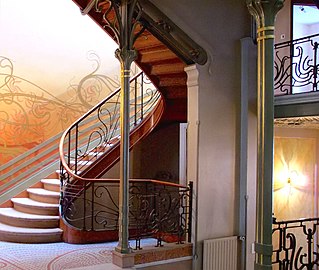
Stairway of the Hôtel Tassel
-
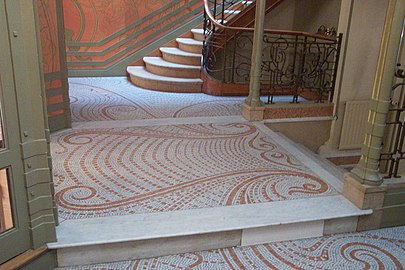
Floor of the Hôtel Tassel, with the characteristic crimper vegetal blueprint
Other works [edit]
Horta built several more town houses in variations of the style, each with its own original grapheme. They include the Hôtel van Eetvelde (1895), the Hôtel Winssinger (1895–96), the Hôtel Deprez-Van de Velde (1895–96), the Hôtel Solvay (1895–1900), and the Hôtel Aubecq (1900), as well every bit his own residence (1898–1901), which is now the Horta Museum. He applied the aforementioned original combination of a steel frame, open programme, skylights and functional features, without the ornament and luxury materials, for several larger buildings, including the headquarters of the Belgian Workers' Party (POB/BWP) or Maison du Peuple/Volkshuis (built in 1896–1899, and demolished in 1965). He as well designed several commercial buildings, including the À L'Innovation department store (1901), which burnt downward in 1967 (see L'Innovation department store fire), as well as a large fabric store, the Magasins Waucquez (1905), which is at present the Belgian Comic Strip Heart.
After nearly 1910, Art Nouveau features gradually disappeared from Horta'southward work, as his fashion evolved into a fusion of neoclassicism and early modernism. Major subsequently buildings include the Centre for Fine Arts and Brussels Central Station, which he began in 1910, and which he was notwithstanding working on when he died in 1947.[10]
-
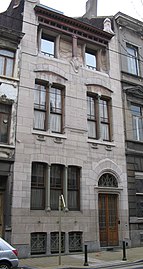
-
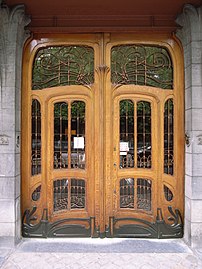
Entrance of the Hôtel Solvay
-

Horta's residence and studio, now the Horta Museum (1898–1901)
-

À L'Innovation department store, pictured shortly later on its opening in 1901
Henry Van de Velde [edit]
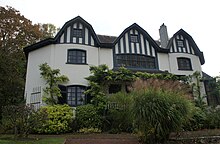
Another major figure in Brussels Art Nouveau was Henry Van de Velde (1863–1957). He began every bit a student of fine art, music and literature, but in 1893 decided, post-obit the influence of the British fabric designer William Morris, to turn to the decorative rather than fine arts. He began designing furniture in 1894, and designed his ain house, Bloemenwerf, in the Uccle municipality of Brussels, based on the Red Firm of Morris. He rejected the influence either of nature or of celebrated styles, and designed houses and decoration purely for functionality. In 1906, he left Belgium for Weimar (Germany), where he began a new career with the High german Werkebund. After spending the First World War in Switzerland, he returned to Brussels where, from 1925 to 1935, he directed the College Schoolhouse of Decorative Arts. In 1947, he settled in Switzerland, where he died in 1957.[eleven]
Josef Hoffmann and the Stoclet Palace (1905–1911) [edit]
Brussels has the earliest Art Nouveau houses, and also the finest example of a tardily Fine art Nouveau or Vienna Secession house, the Stoclet Palace (1905–1911), past Josef Hoffmann, in the Woluwe-Saint-Pierre municipality. The building has virtually null in common with the first Art Nouveau houses, except a certain audacity and willingness to pause all the previous styles' rules. It was built for the Brussels banker and fine art collector Adolphe Stoclet, who met Hoffmann in Vienna, and was impressed by his work. The exterior of the Palace is assembled out of large marble cubes, mounting to a tower. The only decoration on the exterior is a small-scale work of sculpture by Franz Metzner over a doorway, and narrow, stylised bands of sculpture accenting the cubes' horizontal and vertical edges.
The interior is much more lavish, with a richness of varied stones and woods, only information technology is also incessantly geometric. The virtually famous feature is the ceramic frieze in the dining room by the Austrian symbolist painter Gustav Klimt.[12] The firm was declared a UNESCO Globe Heritage Site in 2009.[1]
-

-

Windows of the Stoclet Palace
-
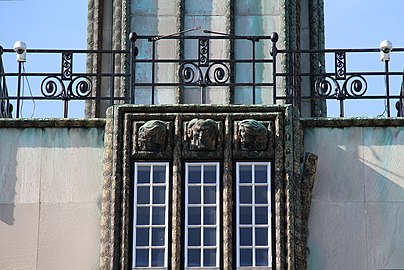
Particular of the facade, fabricated of reinforced concrete covered with marble plaques
-
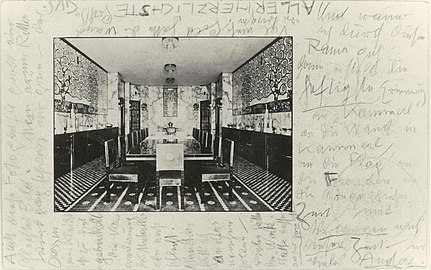
Photo of the Stoclet Palace'south dining room, with furniture by Hoffmann and ceramic frieze by Gustav Klimt
Other notable Brussels architects [edit]
Other notable Art Nouveau architects in Brussels include:
- Paul Saintenoy (1862–1952), who adapted many elements introduced past Horta, including slender fe columns, bow windows, and balustrades with curling lines. His about famous work is the former Old England section store (1898–99), on the Rue Montagne de la Cour / Hofberg , in central Brussels, now the Musical Instruments Museum (MIM). It features natural calorie-free, rich ornamentation of iron grill-work and ceramic tiles, and an open up floor program. In 1899, he likewise completed the kickoff apartment building in Brussels built of reinforced physical.[13]
- Léon Sneyers (1877–1958). Sneyers was trained by Hankar, and and then became his collaborator, working in particular on the Belgian participation in the 1902 Turin Exposition of Decorative Arts, which brought Belgian blueprint to a wider European audience. He designed many displays for expositions beyond Europe. He was attracted to the style of the Wiener Werkstätte, and ran a gallery which promoted their products in Brussels.[14]
- Gustave Strauven (1878–1919). Strauven began his career as a designer working with Horta, then fabricated some of the most extravagant Fine art Nouveau buildings in Brussels. The best-known is the house of the painter Georges de Saint-Cyr at eleven, square Ambiorix / Ambiorixsquare (1901–1903). The house is merely 4 metres (13 ft) wide, but is given boggling height by his elaborate architectural inventions. It is entirely covered past polychrome brick and a network of curling vegetal forms in cast iron.[fifteen]
- Paul Cauchie (1875–1952). Cauchie was an architect, decorator, painter, furniture designer, and a specialist in sgraffito, the Renaissance technique of decorating a facade with murals made of tinted plaster applied to a wet surface. He founded his ain enterprise in Brussels in 1896 to decorate houses with this technique, which was widely used in the Fine art Nouveau menstruation. He designed his own firm in 1905, at 5, rue des Francs / Frankenstraat , with a facade almost entirely covered with sgraffito. He also busy the interior with friezes, furniture and woodwork he had designed.[16]
-

-
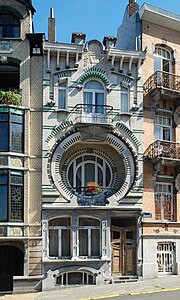
House of the builder Arthur Nelissen (1905)
-
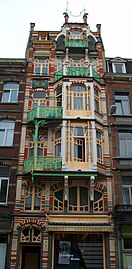
Disproportionate facade with curved lines of the De Beck building by Strauven (1905)
Painting and Sgraffito [edit]
One particular aspect of Brussels' Art Nouveau was the use of sgraffito for exterior or interior decoration. This was a technique invented during the Renaissance, involving applying layers of tinted plaster to a clammy wall. It was used in particular by builder Paul Hankar on the facades of houses. The creative person-decorator Paul Cauchie made sgraffito for the facade of his own residence, every bit did the painter Albert Ciamberlani.
-
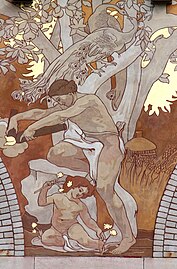
Sgraffito past Albert Ciamberlani for his residence on the Rue Defacqz / Defacqzstraat (1897–98)
-

Sgraffito by Cauchie on the Rue Malibran / Malibranstraat (1900)
-

Sgraffito by Cauchie on his residence and studio (1905)
-

Sgraffito console in the Cauchie Business firm
Drinking glass fine art [edit]
Glass art was a medium in which Fine art Nouveau found new and varied means of expression. Intense amount of experimentation went on to discover new effects of transparency and opacity: in engraving with cameo, double layers, and acid engraving, a technique which permitted production in series. Philippe Wolfers (1858–1929), whose store was located in Brussels, was 1 of the pioneers of the style. He not just created vases in organic and floral forms, but too jewellery, bronzes, lamps, glassware, and other decorative objects, produced mostly for the leading Belgian drinking glass mill of Val Saint Lambert. Wolfers was noted specially for creating works of symbolist glass, ofttimes with metal decoration fastened. [17] [18]
-

Vase by Wolfers (1899)
-
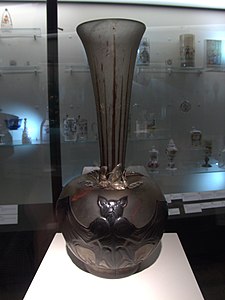
Crépuscule ("Twilight") vase with bat design by Wolfers (1901)
-

Another feature of Brussels' Art Nouveau was the use of stained glass windows with that way of floral themes in residential salons. Victor Horta used stained drinking glass windows, combined with ceramics, wood and atomic number 26 decoration with similar motifs, to create a harmony between functional elements and decoration, making a unified work of fine art or Gesamtkunstwerk ("total work of art"). One instance is the stained glass window of the doorway of the Hôtel van Eetvelde (1895).
-

Furnishings of the Hôtel Aubecq by Horta (1899–1902) on display at the Musée d'Orsay, Paris
-

Detail of La Marjolaine storefront by Léon Sneyers (1904)
Metallic art [edit]
Art Nouveau architecture made use of many technological innovations of the late 19th century, specially the apply of exposed fe and large, irregularly shaped pieces of drinking glass for compages. The French architectural theorist Eugène Viollet-le-Duc had advocated showing, rather than concealing the iron frameworks of modern buildings, just Brussels' Art Nouveau architects went a step further: they added iron ornament in curves inspired by floral and vegetal forms both in the interiors and exteriors of their buildings. They took the form of stairway railings, low-cal fixtures, and other details in the interior, as well every bit balconies and other ornaments on the outside.[nineteen]
Victor Horta, who had worked on the construction of iron and glass Royal Greenhouses of Laeken, was one of the first to create Art Nouveau ironwork. His use of wrought fe or cast iron in scrolling whiplash forms on doorways, balconies and gratings became some of the about distinctive features of Art Nouveau compages. The utilise of metal decoration in vegetal forms soon also appeared in silverware, lamps, and other decorative items.[19]
-
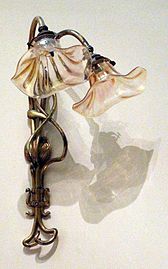
Light fixture by Horta (1903)
Piece of furniture and decoration [edit]
Many Brussels architects, including Victor Horta and Henry Van de Velde, also designed the article of furniture and other interior decoration of their houses. The curving designs of the wood and patterns on the upholstery matched the designs of the walls and other interior features. The piece of furniture was hand-made particularly for each house. One drawback of Fine art Nouveau was that the furniture could not exist changed or replaced with a different style without disrupting the harmony of the room.
Another notable effigy in early Belgian Art Nouveau article of furniture and design was Gustave Serrurier-Bovy (1858–1910). He lived for a time in England, and was influenced past works of William Morris and the Arts and crafts Movement. His work showed the rustic influence of Craft style, but he added his ain elements of asymmetry. He too combined different types of piece of furniture into single units, such as a desk with an attached bookcase, breast of drawers, and cupboard. His later work was much more geometrical, well on the path towards modernism.[20]
-

Chair by Van de Velde for Bloemenwerf (1895)
-

Dining room piece of furniture and wall panel by Victor Horta from the Hôtel Aubecq (1899–1902), now in the Musée d'Orsay
-
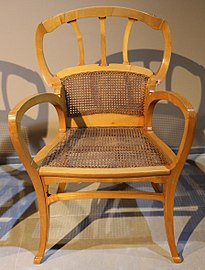
Chair by Horta from the Hôtel Aubecq, now in the Musée d'Orsay
-

Table designed by Horta for the 1902 Turin Exposition
-

Jewellery [edit]
The most prominent Art Nouveau jeweller in Brussels was Philippe Wolfers. He was likewise a sculptor and silversmith, and combined these different skills in a variety of works. He designed jewellery and other objects based on insects, plants, and animals, using previous materials and natural curving forms. His work often crossed the frontiers between sculpture and decorative art, inspired past the lines of forms ranging from dragonflies to bats to Grecian masks. An example is a pendant with a pearl and a swan surrounded by serpents.[21] Another important figure was Frans Hoosemans, who made small works of sculpture, candlesticks and other objects using ivory, silver, and other precious materials.
-

Plumes de Paon ("Peacock Feathers"), belt buckle by Wolfers (1898)
-

Cygne et Serpents ("Swan and Serpents"), pendant by Wolfers (1899–1900)
-

Libelle ("Dragonfly"), pendant made of golden, opal, enamel, rubies and diamonds by Wolfers (1902)
Protection status [edit]
Among Brussels' Art Nouveau creations, 4 buildings by Victor Horta were added to the UNESCO World Heritage List in 2000 nether the title "Major Town Houses of the Builder Victor Horta (Brussels)": the Hôtel Tassel, the Hôtel Solvay, the Hôtel van Eetvelde and the Horta Firm (currently the Horta Museum).[9]
The Stoclet Palace, congenital between 1905 and 1911 by the Austrian architect Josef Hoffmann, one of the founders of the Viennese Secession, has also been listed as a World Heritage Site since 2009.[1]
See as well [edit]
- Fine art Nouveau in Antwerp
- Art Deco in Brussels
- History of Brussels
- Belgium in "the long nineteenth century"
References [edit]
Notes [edit]
- ^ a b c "Stoclet Firm". whc.unesco.org. UNESCO Globe Heritage Middle. Retrieved eight January 2017.
- ^ a b c Culot & Pirlot 2005, p. 74.
- ^ Culot & Pirlot 2005, p. 74–75.
- ^ Oudin 1994, p. 237.
- ^ [1] Victor Horta - Encyclopaedia Britannica
- ^ Oudin 1994.
- ^ Sembach 2013, p. 47.
- ^ Giedion 1941.
- ^ a b "Major Boondocks Houses of the Architect Victor Horta (Brussels)". whc.unesco.org. UNESCO World Heritage Centre. Retrieved 25 August 2018.
- ^ Culot & Pirlot 2005, p. 78–79.
- ^ Culot & Pirlot 2005, p. 89–90.
- ^ Sembach 2013, p. 230–235.
- ^ Culot & Pirlot 2005, p. 85–xc.
- ^ Culot & Pirlot 2005, p. 86–87.
- ^ Culot & Pirlot 2005, p. 87.
- ^ Culot & Pirlot 2005, p. 67.
- ^ Thiébaut 2007, p. 238.
- ^ Fahr-Becker 2015, p. 151–152.
- ^ a b Riley 2004, p. 322.
- ^ Sembach 2013, p. 45.
- ^ Fahr-Becker 2015, p. 152.
Bibliography [edit]
- Culot, Maurice; Pirlot, Anne-Marie (2005). Bruxelles Art Nouveau (in French). Brussels: Archives d'Architecture Moderne. ISBN978-two-87143-126-8.
- Fahr-Becker, Gabriele (2015). Art Nouveau. Rheinbreitbach: H.F. Ullmann. ISBN978-iii-8480-0834-six.
- Giedion, Sigfried (1941). Space Fourth dimension and Compages. Cambridge, MA: Harvard University Press. ISBN978-0-67403-047-3.
- Oudin, Bernard (1994). Dictionnaire des Architectes (in French). Paris: Seghers. ISBN978-two-232-10398-8.
- Riley, Noël (2004). Grammaire des Arts Décoratifs (in French). Paris: Flammarion. ISBN978-2-08-011327-half dozen.
- Sembach, Klaus-Jürgen (2013). L'Art Nouveau- L'Utopie de la Réconciliation (in French). Cologne: Taschen. ISBN978-3-8228-3005-five.
- Thiébaut, Olivier (2007). United nations Ensemble Fine art Nouveau - La Donation Rispal (in French). Paris: Musée d'Orsay - Flammarion. ISBN978-2-08-011608-six.
- Victoir, Jef; Vanderperren, Jos (1992). Henri Beyaert: Du classicisme à fifty'fine art nouveau (in French). St Martens-Latem: Editions de la Dyle. ISBN978-90-801124-1-4.
Source: https://en.wikipedia.org/wiki/Art_Nouveau_in_Brussels

Enregistrer un commentaire for "Rue Lebeau 47 Immeuble Art Nouveau Bruxelles Bruxelles 1000 Belgium"