Arabesque and Floral Designs Arabesque and Floral Designs in Islamic Art


The "Tellus Panel" from the Ara Pacis, in Rome, circa 27 AD. The lower part of the panel is an example of a Roman arabesque
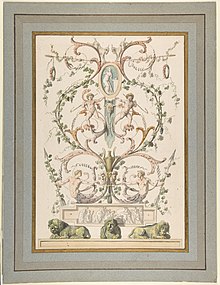
The arabesque is a form of artistic decoration consisting of "surface decorations based on rhythmic linear patterns of scrolling and interlacing foliage, tendrils" or evidently lines,[i] often combined with other elements. Another definition is "Foliate ornament, used in the Islamic earth, typically using leaves, derived from stylised one-half-palmettes, which were combined with spiralling stems".[2] It usually consists of a unmarried design which tin be 'tiled' or seamlessly repeated as many times every bit desired.[3] Within the very broad range of Eurasian decorative art that includes motifs matching this basic definition, the term "arabesque" is used consistently every bit a technical term past art historians to describe simply elements of the decoration found in ii phases: Islamic fine art from virtually the 9th century onwards, and European decorative art from the Renaissance onwards. Interlace and scroll ornamentation are terms used for virtually other types of similar patterns.
Arabesques are a cardinal element of Islamic art but they develop what was already a long tradition by the coming of Islam. The by and current usage of the term in respect of European art can but be described as confused and inconsistent. Some Western arabesques derive from Islamic art, but others are closely based on ancient Roman decorations. In the West they are essentially found in the decorative arts, but because of the generally non-figurative nature of Islamic art, arabesque decoration is in that location frequently a very prominent chemical element in the almost significant works, and plays a large part in the decoration of architecture.
Claims are often fabricated regarding the theological significance of the arabesque and its origin in a specifically Islamic view of the earth; still, these are without support from written historical sources since, like well-nigh medieval cultures, the Islamic globe has not left us documentation of their intentions in using the decorative motifs they did. At the popular level such theories often appear uninformed as to the wider context of the arabesque.[four] In similar manner, proposed connections betwixt the arabesque and Arabic knowledge of geometry remains a subject of debate; not all art historians are persuaded that such knowledge had reached, or was needed by, those creating arabesque designs, although in sure cases there is evidence that such a connection did exist.[5] The case for a connection with Islamic mathematics is much stronger for the development of the geometric patterns with which arabesques are often combined in fine art. Geometric decoration often uses patterns that are made upwardly of straight lines and regular angles that somewhat resemble curvilinear arabesque patterns; the extent to which these too are described every bit arabesque varies between different writers.[6]
Islamic arabesque [edit]
The arabesque developed out of the long-established traditions of establish-based scroll decoration in the cultures taken over by the early Islamic conquests. Early on Islamic art, for example in the famous 8th-century mosaics of the Swell Mosque of Damascus, oft contained found-coil patterns, in that example past Byzantine artists in their usual style. The plants almost ofttimes used are stylized versions of the acanthus, with its emphasis on leafy forms, and the vine, with an equal emphasis on twining stems. The evolution of these forms into a distinctive Islamic type was complete by the 11th century, having begun in the 8th or ninth century in works like the Mshatta Facade. In the process of development the constitute forms became increasingly simplified and stylized.[7] The relatively abundant survivals of stucco reliefs from the walls of palaces (but not mosques) in Abbasid Samarra, the Islamic capital between 836 and 892, provide examples of three styles, Styles A, B, and C, though more than than i of these may appear on the same wall, and their chronological sequence is non certain.[viii]
Though the broad outline of the procedure is generally agreed, at that place is a considerable diversity of views held past specialist scholars on detailed issues apropos the development, categorization and significant of the arabesque.[9] The detailed study of Islamic arabesque forms was begun by Alois Riegl in his formalist report Stilfragen: Grundlegungen zu einer Geschichte der Ornamentik (Problems of style: foundations for a history of decoration) of 1893, who in the process developed his influential concept of the Kunstwollen.[ten] Riegl traced formalistic continuity and development in decorative plant forms from ancient Egyptian art and other ancient Near Eastern civilizations through the classical world to the Islamic arabesque. While the Kunstwollen has few followers today, his basic analysis of the evolution of forms has been confirmed and refined by the wider corpus of examples known today.[xi] Jessica Rawson has recently extended the analysis to cover Chinese fine art, which Riegl did not cover, tracing many elements of Chinese ornamentation back to the same tradition, the shared groundwork helping brand the assimilation of Chinese motifs into Persian art after the Mongol invasion harmonious and productive.[12]
Many arabesque patterns disappear at (or "under", as it often appears to a viewer) a framing border without catastrophe and thus can be regarded as infinitely extendable outside the space they really occupy; this was certainly a distinctive characteristic of the Islamic course, though not without precedent. Well-nigh but not all foliage decoration in the preceding cultures terminated at the edge of the occupied infinite, although infinitely repeatable patterns in foliage are very mutual in the mod earth in wallpaper and textiles.
Typically, in before forms there is no attempt at realism; no particular species of constitute is being imitated, and the forms are often botanically incommunicable or implausible. "Leaf" forms typically spring sideways from the stem, in what is ofttimes called a "half-palmette" form, named afterward its distant and very unlike looking ancestor in ancient Egyptian and Greek ornament. New stems spring from foliage-tips, a type often called honeysuckle, and the stems often have no tips, winding endlessly out of the space. The early Mshatta Facade is recognisably some sort of vine, with conventional leaves on the end of short stalks and bunches of grapes or berries, but after forms unremarkably lack these. Flowers are rare until about 1500, afterward which they announced more often, especially in Ottoman art, and are oft identifiable by species. In Ottoman fine art the large and feathery leaves chosen saz became very pop, and were elaborated in drawings showing just one or more big leaves. Eventually floral decoration more often than not derived from Chinese styles, especially those of Chinese porcelain, replaces the arabesque in many types of work, such every bit pottery, textiles and miniatures.
-

Iznik tile panel with flowers, 1550-1600, in the Louvre
-

"Rosette begetting the names and titles of shah Jahan", page from the shah Jahan album, circa 1645, in the Metropolitan Museum of Art
Significance in Islam [edit]
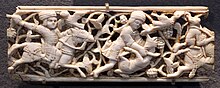
Arabesque pattern backside hunters on ivory plaque, 11th–12th century, Egypt

The arabesques and geometric patterns of Islamic art are frequently said to ascend from the Islamic view of the world (see above). The depiction of animals and people is mostly discouraged, which explains the preference for abstract geometric patterns.
There are two modes to arabesque fine art. The commencement mode recalls the principles that govern the gild of the earth. These principles include the bare basics of what makes objects structurally sound and, past extension, beautiful (i.e. the angle and the fixed/static shapes that it creates—esp. the truss). In the first mode, each repeating geometric form has a congenital-in symbolism ascribed to it. For case, the square, with its four equilateral sides, is symbolic of the equally important elements of nature: earth, air, fire and water. Without any one of the four, the physical globe, represented by a circle that inscribes the foursquare, would collapse upon itself and cease to exist. The second mode is based upon the flowing nature of institute forms. This manner recalls the feminine nature of life giving. In add-on, upon inspection of the many examples of Arabesque art, some would argue that at that place is in fact a 3rd way, the mode of Islamic calligraphy.
Instead of recalling something related to the 'True Reality' (the reality of the spiritual world), Islam considers calligraphy a visible expression of the highest art of all; the art of the spoken give-and-take (the transmittal of thoughts and of history). In Islam, the most of import certificate to be transmitted orally is the Qur'an. Proverbs and complete passages from the Qur'an tin be seen today in Arabesque art. The coming together of these three forms creates the Arabesque, and this is a reflection of unity arising from variety; a basic tenet of Islam.
The arabesque may be equally thought of equally both art and science. The artwork is at the aforementioned time mathematically precise, aesthetically pleasing, and symbolic. Due to this duality of cosmos, the artistic part of this equation may be further subdivided into both secular and religious artwork. Yet, for many Muslims there is no distinction; all forms of art, the natural world, mathematics and science are seen to exist creations of God and therefore reflections of the same thing: God'southward volition expressed through his creation. In other words, man tin can discover the geometric forms that constitute the arabesque, but these forms always existed before as part of God's creation, equally shown in this moving-picture show.
In that location is great similarity between arabesque artwork from very different geographic regions.[13] In fact, the similarities are then pronounced that it is sometimes difficult for experts to tell where a given way of arabesque comes from. The reason for this is that the scientific discipline and mathematics that are used to construct Arabesque artwork are universal. Therefore, for most Muslims, the all-time artwork that can be created by homo for utilize in the Mosque is artwork that displays the underlying society and unity of nature. The order and unity of the material earth, they believe, is a mere ghostly approximation of the spiritual globe, which for many Muslims is the place where the merely true reality exists. Discovered geometric forms, therefore, exemplify this perfect reality because God's creation has been obscured past the sins of man.
Mistakes in repetitions may be intentionally introduced as a show of humility by artists who believe only Allah tin produce perfection, although this theory is disputed.[14] [15] [16] Arabesque fine art consists of a series of repeating geometric forms which are occasionally accompanied by calligraphy. Ettinghausen et al. describe the arabesque every bit a "vegetal design consisting of total...and half palmettes [as] an unending continuous pattern...in which each leafage grows out of the tip of another."[17] To the adherents of Islam, the Arabesque is symbolic of their united faith and the mode in which traditional Islamic cultures view the world.
Terminology and Western arabesque [edit]
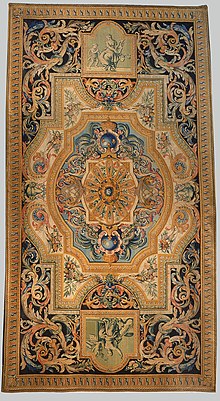

Arabesque is a French term derived from the Italian word arabesco, meaning "in the Standard arabic style".[18] The term was first used in Italian, where rabeschi was used in the 16th century as a term for "pilaster ornaments featuring acanthus ornament",[19] specifically "running scrolls" that ran vertically up a panel or pilaster, rather than horizontally along a frieze.[20] The volume Opera nuova che insegna a le donne a cuscire … laqual e intitolata Esempio di raccammi (A New Work that Teaches Women how to Stitch … Entitled "Samples of Embroidery"), published in Venice in 1530, includes "groppi moreschi e rabeschi", Moorish knots and arabesques.[21]
From there it spread to England, where Henry 8 owned, in an inventory of 1549, an agate cup with a "fote and Couer of siluer and guilt enbossed with Rebeske worke",[22] and William Herne or Heron, Serjeant Painter from 1572 to 1580, was paid for painting Elizabeth I's barge with "rebeske work".[23] Unfortunately the styles so described tin just be guessed at, although the pattern by Hans Holbein for a covered cup for Jane Seymour in 1536 (see gallery) already has zones in both Islamic-derived arabesque/moresque style (see beneath) and classically derived acanthus volutes.[24]
Another related term is moresque, significant "Moorish"; Randle Cotgrave's A Dictionarie of the French and English language Tongues of 1611 defines this every bit: "a rude or anticke painting, or carving, wherin the anxiety and tayles of beasts, &c, are intermingled with, or made to resemble, a kind of wild leaves, &c."[25] and "arabesque", in its primeval utilise cited in the OED (only as a French word), every bit "Rebeske work; a small and curious flourishing".[26] In French republic "arabesque" first appears in 1546,[27] and "was first applied in the latter role of the 17th century" to grotesque ornament, "despite the classical origin of the latter", especially if without man figures in it - a distinction nonetheless frequently fabricated, but not consistently observed,[28]
Over the post-obit centuries, the 3 terms "grotesque", "moresque", and "arabesque" were used largely interchangeably in English, French, and German for styles of decoration derived at least as much from the European by as the Islamic world, with "grotesque" gradually acquiring its principal modern meaning, related more to Gothic gargoyles and caricature than to either Pompeii-mode Roman painting or Islamic patterns. Meanwhile, the word "arabesque" was now being applied to Islamic art itself, by 1851 at the latest, when John Ruskin uses it in The Stones of Venice.[29] Writers over the last decades take attempted to save meaningful distinctions betwixt the words from the confused wreckage of historical sources.
Peter Fuhring, a specialist in the history of ornament, says that (also in a French context):
The ornament known as moresque in the fifteenth and sixteenth centuries (but now more than ordinarily chosen arabesque) is characterized by bifurcated scrolls composed of branches forming interlaced leafage patterns. These basic motifs gave rise to numerous variants, for example, where the branches, generally of a linear character, were turned into straps or bands. ... It is characteristic of the moresque, which is essentially a surface ornament, that information technology is impossible to locate the design's start or end. ... Originating in the Middle E, they were introduced to continental Europe via Italy and Espana ... Italian examples of this ornament, which was oftentimes used for bookbindings and embroidery, are known from as early on as the late fifteenth century.[xxx]
Fuhring notes that grotesques were "confusingly chosen arabesques in eighteenth century France", merely in his terminology "the major types of ornamentation that appear in French sixteenth century etchings and engraving... can be divided into two groups. The showtime includes ornaments adopted from antiquity: grotesques, architectural ornaments such equally the orders, leafage scrolls and self-contained elements such as trophies, terms and vases. A second group, far smaller than the starting time, comprises modern ornaments: moresques, interlaced bands, strapwork, and elements such equally cartouches...", categories he goes on to hash out individually.[31]
The moresque or arabesque mode was especially popular and long-lived in the Western arts of the book: bookbindings decorated in gold tooling, borders for illustrations, and printer's ornaments for decorating empty spaces on the page. In this field the technique of gold tooling had also arrived in the 15th century from the Islamic earth, and indeed much of the leather itself was imported from there.[32] Small-scale motifs in this mode have continued to be used past bourgeois book designers upwards to the present day.
According to Harold Osborne, in France, the "characteristic development of the French arabesque combined bandwork deriving from the moresque with decorative acanthus foliage radiating from C-scrolls continued by short bars".[xix] Plain starting in embroidery, information technology and then appears in garden design before existence used in Northern Mannerist painted decorative schemes "with a central medallion combined with acanthus and other forms" by Simon Vouet and then Charles Lebrun who used "scrolls of flat bandwork joined by horizontal bars and contrasting with ancanthus scrolls and palmette."[33] More exuberant arabesque designs past Jean Bérain the Elder are an early "intimation" of the Rococo, which was to take the arabesque into three dimensions in reliefs.[34]
The use of "arabesque" as an English language noun first appears, in relation to painting, in William Beckford's novel Vathek in 1786.[26] Arabesque is too used equally a term for complex freehand pen flourishes in cartoon or other graphic media. The Grove Lexicon of Fine art will accept none of this confusion, and says flatly: "Over the centuries the word has been applied to a wide variety of winding and twining vegetal ornament in art and meandering themes in music, but it properly applies just to Islamic art",[35] so contradicting the definition of 1888 still found in the Oxford English Dictionary: "A species of landscape or surface ornament in color or low relief, composed in flowing lines of branches, leaves, and ringlet-work fancifully intertwined. Also fig[uratively]. Equally used in Moorish and Arabic decorative fine art (from which, almost exclusively, information technology was known in the Middle Ages), representations of living creatures were excluded; merely in the arabesques of Raphael, founded on the ancient Græco-Roman work of this kind, and in those of Renaissance decoration, homo and creature figures, both natural and grotesque, likewise as vases, armour, and objects of art, are freely introduced; to this the term is now usually applied, the other being distinguished as Moorish Arabesque, or Moresque."[36]
-

Renaissance Revival cast iron door window grill of a building on Rue du Bac from Paris
-

Art Nouveau arabesque on a façade of a metropolis-house from Bucharest
Printing [edit]
A major utilize of the arabesque mode has been creative printing, for case of book covers and page ornamentation. Repeating geometric patterns worked well with traditional printing, since they could exist printed from metal type like messages if the type was placed together; as the designs have no specific connectedness to the pregnant of a text, the type can be reused in many different editions of dissimilar works. Robert Granjon, a French printer of the sixteenth century, has been credited with the outset truly interlocking arabesque press, but other printers had used many other kinds of ornaments in the past.[37] The idea was quickly used by many other printers.[38] [39] [forty] After a menstruum of disuse in the nineteenth century, when a more minimal folio layout became popular with printers like Bodoni and Didot, the concept returned to popularity with the arrival of the Craft move, Many fine books from the period 1890-1960 have arabesque decorations, sometimes on paperback covers.[41] Many digital serif fonts include arabesque pattern elements thought to exist complementary to the mood of the font; they are also often sold as separate designs.[42]
-

Arabesque/moresque printers ornament, German, 17th century
-

Arabesque pen flourishes on a signature
Notes [edit]
- ^ Fleming, John; Honour, Hugh (1977). Dictionary of the Decorative Arts. Penguin. ISBN978-0-670-82047-4.
- ^ Rawson, 236
- ^ Robinson, Francis (1996). The Cambridge Illustrated History of the Islamic World . Cambridge Academy Press. ISBN978-0-521-66993-ane.
- ^ Tabbaa, 74-77
- ^ Tabbaa, 88
- ^ Canby, xx-21
- ^ Tabbaa, 75-88; Canby, 26
- ^ Necipoğlu, Gülru, Payne, Alina, Histories of Ornament: From Global to Local, 88-90, 2016, Princeton University Press, ISBN 0691167281, 978069116728, google books; "Museum of Islamic Art, Berlin: Objects from Samarra"; Ettinghausen et al, 57-59; examples of styles A, B, and C illustrated.
- ^ Tabbaa's Chapter 4 gives an overview of these questions.
- ^ Tabbaa, 74-75
- ^ Rawson, 24-25; meet also ""Style"—or whatever", J. Duncan Berry, A review of Issues of Way past Alois Riegl, The New Criterion, April 1993
- ^ Rawson, the subject of her book, see Preface, and Affiliate 5 on Chinese influences on Persian fine art.
- ^ Wade, David (March 2006). "The Evolution of Style". Blueprint in Islamic Art . Retrieved 19 December 2015.
- ^ Thompson, Muhammad; Begum, Nasima. "Islamic Textile Art: Anomalies in Kilims". Salon du Tapis d'Orient. TurkoTek. Retrieved 25 August 2009.
- ^ Alexenberg, Melvin L. (2006). The future of art in a digital age: from Hellenistic to Hebraic consciousness . Intellect Ltd. p. 55. ISBN1-84150-136-0.
- ^ Backhouse, Tim. "Simply God is Perfect". Islamic and Geometric Art . Retrieved 25 August 2009.
- ^ Ettinghausen et al, 66.
- ^ "Arabesque | Definition of Arabesque by Lexico". Lexico Dictionaries | English . Retrieved 2019-11-22 .
- ^ a b Osborne, 34
- ^ Fuhring, 159
- ^ Met Museum; the Italian discussion uses the Latin derived "inceptive" or "inchoative" word ending "-esco" signifying a outset, thus ferveo, to boil and fervesco to begin to boil.
- ^ OED, "Arabesque":"1549 Inventory Henry Eight (1998) 25/ii Item one Cuppe of Agathe the fote and Couer of siluer and guilt enbossed with Rebeske worke";
- ^ "rebeske" being a now disused version of "arabesque", see OED, "Rebesk". Herne payment quoted in Erna Auerbach, Tudor Artists, 1954; non in print OED
- ^ Marks, Richard and Williamson, Paul, eds. Gothic: Art for England 1400-1547, 156, 2003, V&A Publications, London, ISBN 1-85177-401-seven. For other Renaissance ornament from Henry'south courtroom, encounter besides no 13 on page 156, and pp. 144-145, 148-149.
- ^ OED, "Moresque", citing Cotgrave
- ^ a b OED, "Arabesque"
- ^ Larrouse dictionary
- ^ Osborne, 34 (quoted), run into too OED quoted below and Cotgrave - Osborne says the French usage begins in the "latter part of the 17th century" simply in the following paragraphs describes a development beginning rather before this.
- ^ The Stones of Venice, chapter 1, para 26
- ^ Fuhring, 162
- ^ Fuhring, 155-156
- ^ Harthan, ten-12
- ^ Osborne, 34-35
- ^ Osborne, 35
- ^ Oxford Fine art Online, "Arabesque", accessed March 25, 2011
- ^ OED, printed and online editions (accessed March 2011)
- ^ Johnson, Henry Lewis (1991). Decorative ornaments and alphabets of the Renaissance : 1,020 copyright-free motifs from printed sources. New York: Dover Publications. ISBN9780486266053.
- ^ "Hoefler Text: Arabesques". Hoefler & Frere-Jones. Retrieved 17 August 2015.
- ^ Plomer, Henry R. (1924). English printers' ornaments. Mansfield Centre, CT: Martino Pub. ISBN9781578987153 . Retrieved 17 Baronial 2015.
- ^ Johnson, Henry Lewis (1923). Celebrated Pattern in Press. Boston, MA: Graphic Arts Company. Retrieved 17 August 2015.
- ^ Brandt, Beverly Chiliad. (2009). The craftsman and the critic : defining usefulness and beauty in arts and crafts-era Boston. Amherst: Academy of Massachusetts Press. p. 67. ISBN9781558496774.
- ^ "Moresque second". MyFonts . Retrieved 17 Baronial 2015.
References [edit]
- Canby, Sheila, Islamic art in particular, Us edn., Harvard University Printing, 2005, ISBN 0-674-02390-0, ISBN 978-0-674-02390-ane, Google books
- Richard Ettinghausen, Oleg Grabar, and Marilyn Jenkins-Madina, Islamic Art and Architecture, 650-1250. (New Oasis: Yale UP, 2001)
- Fuhring, Peter, Renaissance Ornament Prints; The French Contribution, in Karen Jacobson, ed (often wrongly cat. equally George Baselitz), The French Renaissance in Prints, 1994, Grunwald Center, UCLA, ISBN 0-9628162-2-1
- Harthan, John P., Bookbinding, 1961, HMSO (for the Victoria and Albert Museum)
- Rawson, Jessica, Chinese Ornament: The Lotus and the Dragon, 1984, British Museum Publications, ISBN 0-7141-1431-6
- Osborne, Harold (ed), The Oxford Companion to the Decorative Arts, 1975, OUP, ISBN 0-19-866113-four
- Tabbaa, Yasser, The transformation of Islamic fine art during the Sunni revival, I.B.Tauris, 2002, ISBN ane-85043-392-5, ISBN 978-ane-85043-392-7, Google books
External links [edit]
 | Wikimedia Commons has media related to Arabesque. |
- Abdullahi Y., Embi K. R. B, Development Of Abstract Vegetal Ornaments On Islamic Compages, International Journal of Architectural Research, 2015, Archnet-IJAR

Enregistrer un commentaire for "Arabesque and Floral Designs Arabesque and Floral Designs in Islamic Art"